PUTTING NUTRITION LABEL INFORMATION TO USE
Last week I talked all about the logistics of a nutrition label: what the various sections mean, where to find information, and how to understand what you’re looking at. Which is all very valuable information, but also different from putting this information to use in your life (now and when life changes).
So even if you are well-versed in all the information that you find on the back of food packaging, it doesn’t mean that the act of flipping a box or bag or can over should come with the same intention all the time, across all seasons of life, or even from person to person.
WHERE TO START: WHAT’S YOUR CURRENT GOAL(S)?
Two people can look at the exact same nutrition label and come to completely different conclusions – AND both people could be right.
Let’s use a protein bar as an example – the image below is the brand David, and the flavor is Salted Peanut Butter.
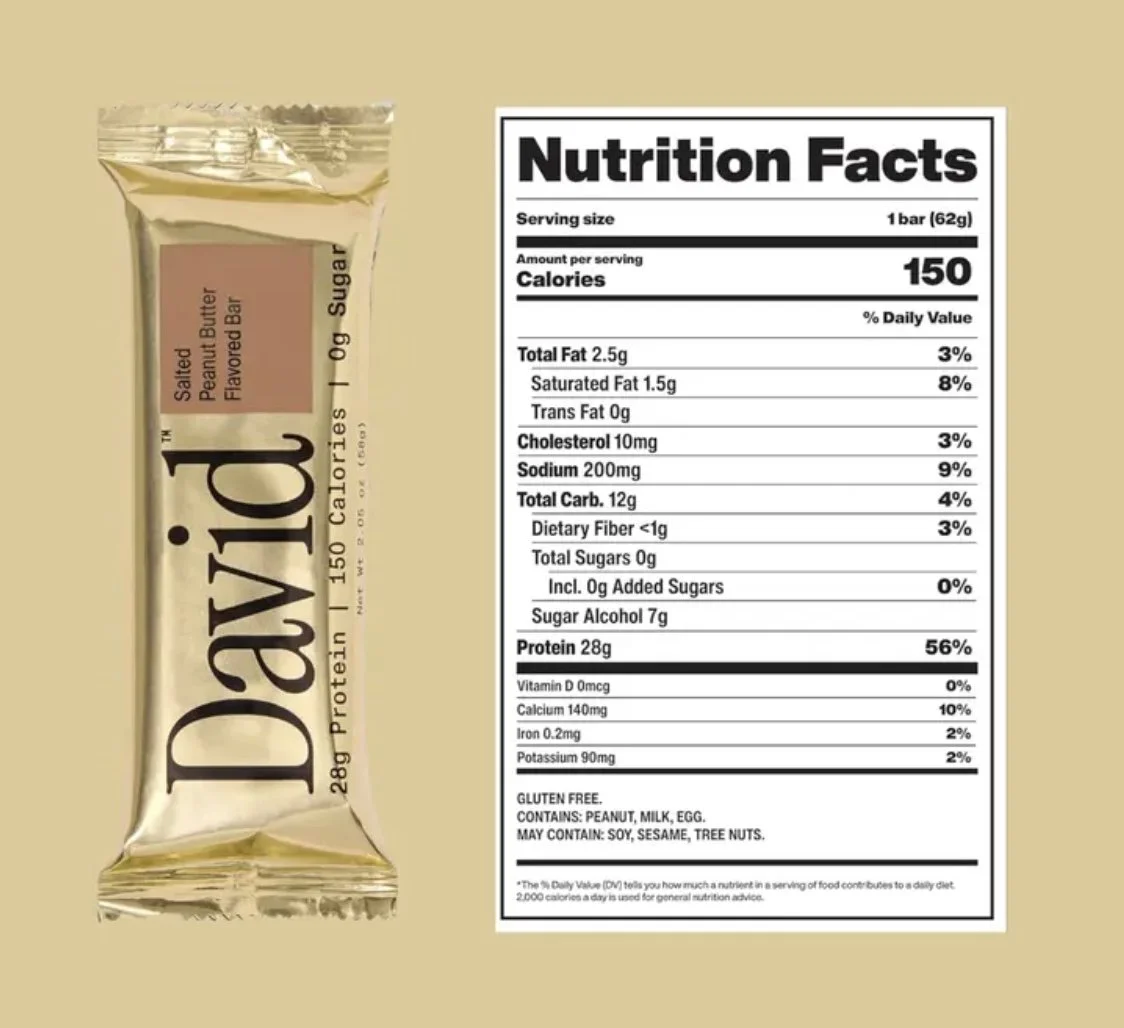
Someone who is actively working on increasing their protein intake may look immediately at the protein content, asking themselves, “how does this help move me toward my goal?” And for an item like a protein bar (“protein” is in the name, after all), it might seem like that’s the “only” thing to look at, nutritionally.
But others, with differing goals may think differently.
Someone focused on digestive health may look at the fiber content first. For them, this is the priority.
An endurance athlete may care more about checking in on the carbohydrates because they have their performance goals top of mind; and for them, this is priority.
A person managing a food allergy might skip all macros on the label and first hone in on the ingredient list to be sure they are not triggering any reactions.
And all of these are the “right” way to look at the label for that particular person, with their particular goal(s). A great first question to ask yourself – before you even start scanning a label – is “what am I looking for?” Once you have identified this, nutrition labels can become less complex to navigate.
YOU DON’T NEED TO EVALUATE EVERYTHING
Having competing priorities can make finding the right foods for your goals more confusing, and in a lot of ways can lead to information overload (and overwhelm). A food that is high in protein, high in fiber, lower in sugar, moderate in calories, minimally processed, affordable, convenient, delicious (etc. etc. etc.) might sound wonderful on paper, but often creates an impossible standard.
This is where, again, it can be really helpful to identify one or two pieces of information that are most relevant to your goals, season of life, and capacity. And while a lof of this information can be found on the nutrition label, some of it may not be. (I know this post is about the nutrition label, but stick with me here!) Working on increasing protein or fiber? On the label. Trying to find a good pre-workout snack? That’s on the label, too (check in with the carbs). Searching for options that fit a busy schedule? Check the frozen section of the grocery store, or take a peek at the pre-cut section in the produce department, and then from there check in with the label. All of these are valid reasons and steps to take!
SPEAKING OF WHICH: CONVENIENCE COUNTS, TOO
Giving this its own section because I believe it’s a conversation that is very often overlooked – sometimes we become so focused on finding the foods that fit our goals in the exact ways that we want and need them too, but completely forget about the realities of our daily lives.
A protein bar that lives in your purse and gets eaten during a busy afternoon may support your goals far more than a multi-faceted meal that never gets made because life got hectic. A frozen meal provides wayyyy more nourishment than skipping dinner entirely (if you’ve been here a minute, you know I highly encourage getting to know, love, and appreciate the freezer section). Rotisserie chicken? It will surely support your goals better than the elaborate recipe that you ran out of energy to prepare.
(None of this is cheating or cutting corners, if that’s what your brain is telling you.)
Nutrition labels can tell us many things, but they cannot tell us whether a food is realistic for your lifestyle. Context is so important!
“HOW DOES THIS FIT?”
If I had a dime for every time I hear “is X healthy?” …I’d have a lot of dimes. I get why we are programmed to ask it, and I also don’t think it’s the most useful question to be asking.
“How does this fit?” or “What purpose does this food serve?” or “What role is this food playing right now?” puts us in a much better position to be thinking about the value of that food for you. Because “healthy eating” isn’t determined by one single food – eating a single piece of fruit for breakfast doesn’t make you “healthy” just like a cookie for dessert doesn’t make you “unhealthy.” Similarly, a “healthy lifestyle” isn’t determined by one single activity – one run doesn’t make you healthy, just like a Saturday afternoon of hanging on your couch doesn’t make you unhealthy. Overall patterns that we create over time and the trends we see as a result of those habits will always trump one thing in isolation.
Again, context matters: a bowl of cereal may be a fantastic breakfast for one person and not particularly filling for another; a protein bar may be exactly what someone needs before practice; a meal made from pantry staples that don’t require any chopping or cooking may be the difference between eating dinner and skipping it altogether. And that's why two people can look at the same food and come to different conclusions.
SO…WHAT’S THE TAKEAWAY?
Perhaps the most important thing to remember when reading a nutrition label is that it is not a report card – the facts are not assigning a grade to the food you choose, and the label is not assigning a grade to you. It is simply providing information, and information helps to drive our decision-making.
The goal isn’t (and has never been) to find the elusively “perfect” food. The goal is to find foods that support your goals, preferences, lifestyle, budget, and season of life. The goal isn’t to have a nutrition label make a decision for us, but rather to use the information that we have at our fingertips to make decisions for ourselves.
YOUR NEXT STEP
Does this blog post resonate with you? At Front Porch Nutrition, I coach real people through real-life nutrition — thinking through what your wants, needs, and goals are, and working together to make changes that last not just in the moment, but for the long haul. Get started with 1:1 nutrition coaching today!