READING A NUTRITION LABEL: WHAT IT ALL MEANS
Nutrition labels can feel a little overwhelming. There are numbers everywhere and percentages that feel important, but what does the information all mean?? And what, if anything (or everything?!) is worth evaluating before tossing the box in your cart?
The great news is that you don’t need to memorize nutrition labels or become a nutrition scientist to understand them, or to understand what the facts and figures mean to your lifestyle, needs, and progress. The goal of this post is simple: to help you be able to decipher what you are looking at when you turn a package over. (And part two of this series will equip you to decide what information on the label actually matters for you.)
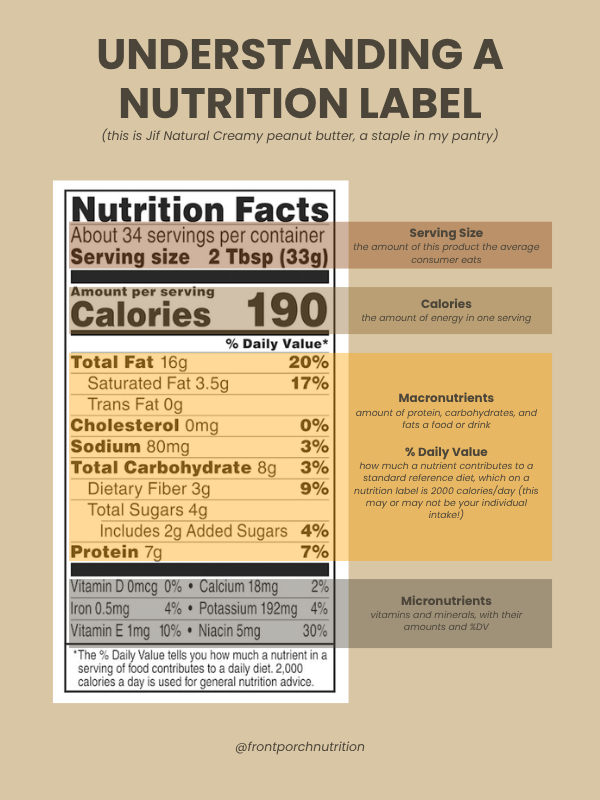
START WITH THE SERVING SIZE
In my opinion, the serving size is one of the most important pieces of information on the label – and also the most misunderstood. While a serving size is a recommendation in a way (it reflects an amount that the producer thinks the average consumer will eat or drink), it is certainly not a rule that you have to follow. It is not the “correct” amount to eat; it is simply the amount used to calculate all of the information that follows. It is a way to say “if you eat X amount, this is the nutrition that is included in that portion.” If you have a single takeaway from this post, please think of serving sie as context, not instruction.
CALORIES + MACRONUTRIENTS
CALORIES
Calories = a measure of energy. Your body uses (and needs) energy all day long for things like fueling a workout, yes, and also for breathing, digesting food, moving, thinking, and recovery. A number of calories tells you how much energy is provided in one serving of that food, and the specific macronutrient breakdown gives us a little more insight on what our body is able to do with that energy.
Fats: support hormone production, nutrient absorption, cell function, and more. They are our densest macronutrient, which often makes a food with a higher fat content feel more filling.
Carbohydrates: our bodies' preferred source of energy, which makes them important for, well, existing, but especially important when considering your movement and exercise.
Protein: supports muscle repair, recovery, immune function, and supporting the feeling of satisfaction between meals.
FIBER
Fiber content is found under carbohydrates because it is a type of carb – one that supports our digestive health, fullness, blood sugar management, and overall health. Most people are not consuming the recommended amount of fiber (current dietary guidelines recommend adults are getting at least 25g/day), making this another part of the nutrition label that I encourage focusing on.
TOTAL SUGAR VS. ADDED SUGAR
Ahhhh, another section that is set to provide data, but also creates a lot of confusion 🫠
Total sugars includes all of the sugar found in a food, whether it occurs naturally (like lactose in milk or fructose in fruit) or is added during manufacturing. Added sugars refers only to sugars that were added to the product, such as cane sugar, honey, maple syrup, or other sweeteners – often added to enhance flavor, sweetness, or texture. For example, a strawberry contains naturally occurring sugar, so it would contribute to total sugars, but it contains no added sugars. A strawberry-flavored yogurt, on the other hand, may contain both naturally occurring sugars from the milk and berries, as well as added sugars used for sweetness. This distinction can provide useful context, but it's important to remember that a food containing added sugar is not automatically "unhealthy," just as a food with no added sugar is not automatically "healthy." As with most things in nutrition, the bigger picture matters more than any single number on a label.
MICRONUTRIENTS
Near the bottom of the nutrition label, you’ll often see other nutrients, like Vitamin D, potassium, iron, and calcium (these four are the only ones currently required by the FDA, but oftentimes others are listed, too; these can be naturally occurring in the food, or added for fortification). These vitamins and minerals play important roles throughout the body and contribute to our overall health. Like in the macronutrients section above it, these are listed in actual amount (typically either mg or mcg) and percent daily value (%DV).
…BUT WHAT ABOUT % DAILY VALUE
The percent daily value (represented as %DV) tells you how much a nutrient contributes to a standard reference diet – which is another number that deserves some consideration. The “standard diet” that is set for a nutrition label in the United States is 2000 calories/day – perhaps this is about your intake, but there is a very good chance it is not. In other words, it can be useful information as a starting point, but it’s also very important to remember that your individual needs may be (and are very likely) different than those used to create the label.
Which, again, is yet another reason why nutrition labels are only part of the story and that a lens of personal context needs to be used.
SO…THE BIG PICTURE
A nutrition label is many things with a lot of information, and at the end of the day, it is just that: information. It is not a report card or a descriptor of good/bad/healthy/unhealthy food. Learning how to read that information is the first step; learning how to apply it to your own goals, preferences, and lifestyle is the next (equally as important) part. (Stay tuned for part 2 to be published next week!)
YOUR NEXT STEP
Ever experience the overwhelm that can come with reading nutrition labels (or consuming any nutrition information!) and wondering “but how does this apply to me?!” At Front Porch Nutrition, I coach real people through real-life nutrition — thinking through what your wants, needs, and goals are, and working together to make changes that last not just in the moment, but for the long haul. Get started with 1:1 nutrition coaching today!