ALL THE ENERGY YOU USE IN A DAY: WHERE YOUR ENERGY EXPENDITURE IS ACTUALLY COMING FROM
When most people think of “burning calories,” they think about workouts. And before you keep reading, I want to offer you a quick reframe – or perhaps just another way to think about the energy you are “burning.”
As humans, we do two very important things with energy: we gain it and we lose it. The gaining it is pretty straightforward – the energy we get comes from the things we consume (or eat and drink, like food and beverages). The losing, or the expenditure (or what we often hear as “burning”) comes from a variety of factors, so while that strength training session or treadmill run absolutely contributed to your overall energy expenditure, it’s only a piece of the puzzle – and that’s what this post is about. Understanding where your energy expenditure, or usage, actually comes from can help you approach nutrition and movement with more nuance and intentionality (and hopefully less frustration if you’ve ever felt any of that).
Our bodies use energy all day long in many ways that have nothing to do with the gym, or even movement in general. Breathing, digesting food, walking down the driveway to your mailbox, fidgeting at work or watching television, chopping vegetables at the kitchen counter, playing with your kids or pets – your body is never really “off.”
WHAT IS TOTAL DAILY ENERGY EXPENDITURE (TDEE)?
Total Daily Energy Expenditure (TDEE) = the total amount of energy (or calories) your body uses in a day.
If the entirety of the energy we use every day is like a completed puzzle, there are four pieces to the puzzle:
Basal Metabolic Rate (BMR),
Thermic Effect of Food (TEF),
Exercise Activity Thermogenesis (EAT), and
Non-Exercise Activity Thermogenesis (NEAT)
These pieces are all different sizes (and there is nuance that depends on many factors); and contrary to popular belief, our workouts are not the biggest contributor.
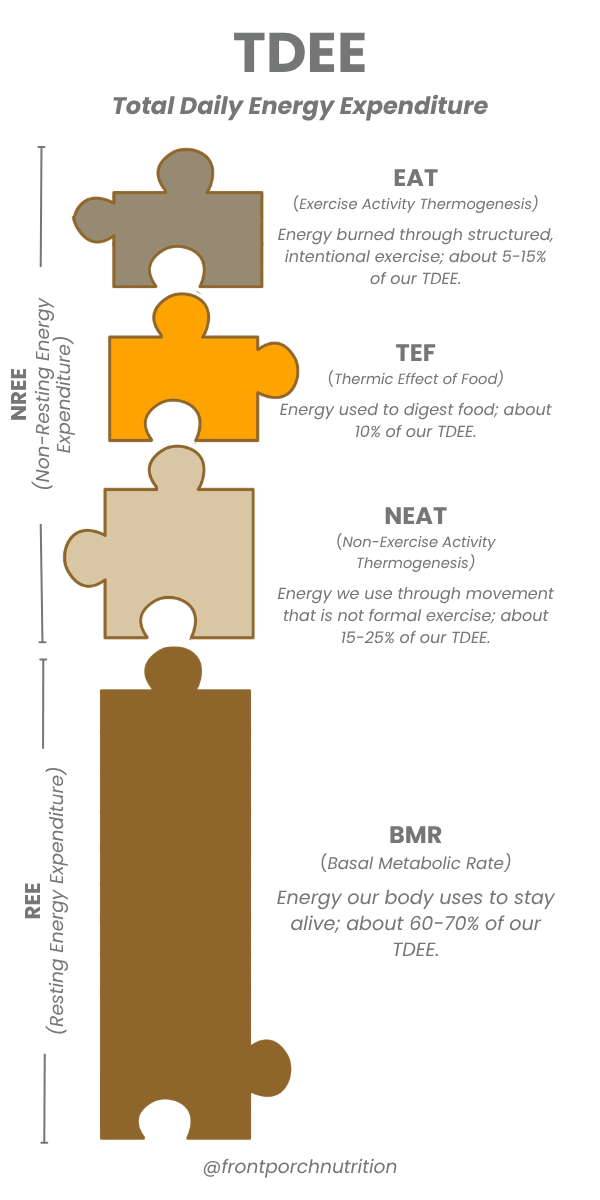
BASAL METABOLIC RATE (BMR)
This is the energy that our bodies use to keep us alive. BMR covers basic bodily functions like breathing, circulating blood, organ function, body temperature regulation, cellular repair and recovery, and more.
In other words, even if you stayed in bed all day doing absolutely nothing, your body would still require a significant amount of energy to function. (You may also recognize your BMR as the smallest amount of energy/lowest number of calories your body needs to stay alive.)
For most people, this is the largest component of daily energy expenditure. It is a major reason why your metabolism is not “broken” just because of a missed workout or a day with a lower step count. Our bodies are doing a ton behind the scenes.
THERMIC EFFECT OF FOOD (TEF)
Digesting food doesn’t just happen – our bodies require energy for the process. We need to break down food, absorb those nutrients, transport them, and store and utilize those nutrients.
Of the three main macronutrients (protein, carbohydrates, and fats), protein has the highest thermic effect, meaning it takes the most energy to use; this is one of several reasons why higher-protein diets are often supportive for satiety, muscle retention, and overall nutrition goals.
This doesn’t mean that you can or should obsess over “hacking” (ugh I hate that term) your metabolism through your food choices…but it does remind us that the body is a machine that is constantly “on” and is always working.
EXERCISE ACTIVITY THERMOGENESIS (EAT)
This is the category that I think most people are most familiar with; this is the structured, intentional exercise that we participate in. Activities like strength training, running, cycling, yoga, fitness classes, sports, or intentional cardio all fit into this category of our daily energy expenditure.
Exercise absolutely matters. It can improve our cardiovascular health, strength, muscle mass and bone density, mobility, mental health, insulin sensitivity, and overall quality of life. An important note about exercise though as it relates to the energy we use daily: it’s a much smaller piece of a person’s TDEE than we assume – which means your progress is not solely determined by (maybe influenced by, but absolutely not dependent on) how many calories you burn during a workout.
Maybe this is slightly discouraging, especially if you are looking at the calories burned on your AppleWatch after spin class and letting that dictate your mood or meal choices (this is a topic for an entirely different post!). Here’s a flip: I like to think of it as incredibly freeing. The knowledge that such a small part of our daily energy usage comes from formal exercise shifts the focus away from “earning food” and toward building an overall lifestyle and behaviors that support your goals.
NON-EXERCISE ACTIVITY THERMOGENESIS (NEAT)
NEAT refers to the energy you burn through movement outside of formal exercise. Things like:
walking through the grocery store
cleaning the house
standing while working, folding laundry, chopping vegetables, etc.
pacing during phone calls or commercial breaks (do you even watch the commercials anymore?!)
gardening
taking the stairs
fidgeting
carrying groceries
playing with your kids or pets
walking the dog
These all may seem small by themselves, but over the course of a day (and a week, and a month), they add up. While all parts of our daily expenditure varies from person to person, NEAT can differ massively between individuals. For example, you may complete the same workout program as a friend, but if you have a desk job and they work on their feet, your unstructured daily movement creates a movement differential in both the short and long term. Lots and lots of nuance with every piece of TDEE, and this highlights why two people can “do the same thing” and still have different outcomes.
WHY THIS MATTERS
Understanding energy expenditure helps us move away from all-or-nothing thinking – health, as well as the factors that contribute to our energy spending, are built through many, many actions, and not solely on our workout routines.
Our health is shaped by routines, habits, environment, movement patterns, recovery, stress, sleep, nourishment, lifestyle, and other factors. And is also why trying to “out-work” any of these poor habits usually doesn’t work long term.
SO…
We do not need to be calorie-burning gym-goers to improve our health. (Again, like I mentioned above, exercise absolutely matters, but from an energy perspective, it is not the star of the show.) Movement, strength, daily habits, recovery, consistency – they all matter, and they all add up when it comes to the big and small processes and behaviors that are our energy balance and metabolism.
YOUR NEXT STEP
Does this blog post resonate with you? At Front Porch Nutrition, I coach real people through real-life nutrition — thinking through what your wants, needs, and goals are, and working together to make changes that last not just in the moment, but for the long haul. Get started with 1:1 nutrition coaching today!