SHOULD I “EAT BACK” THE CALORIES I BURN??
If you’re short on time or skimming this post, the short answer is: no, you don’t need to “eat back” the calories you burn.
In fact, one of the first things I request of new clients as we begin working together is that if they already use a tracking app, to toggle off the exercise calories function of the tracking app:
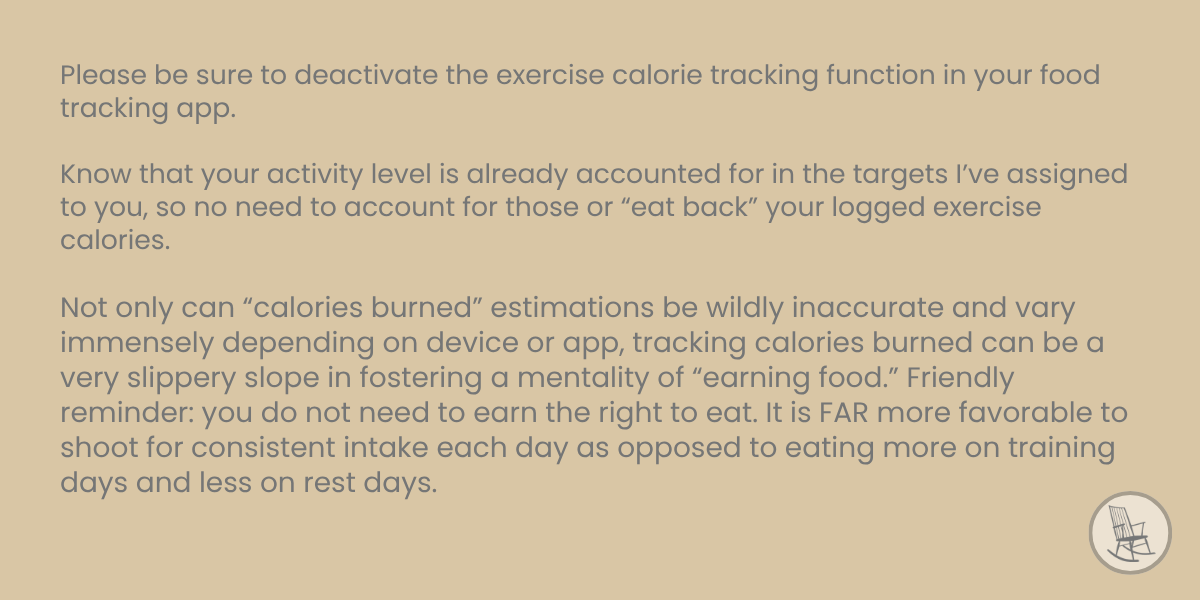
The longer answer: we need to dive a little deeper into why this idea shows up (I mean, you see it on every tracking app…), why it often makes things more confusing than helpful, and how to reframe the relationship between exercise and food intake.
It comes from the idea that most fitness trackers and nutrition apps overly simplify things into two numbers: calories eaten and calories burned. And from there, it can feel logical to “balance” the equation. I burned 400 calories during my workout, so I should eat 400 calories more. Or I rested today and burned 250 calories less than when I trained yesterday, so I should eat 250 calories less. I completely understand how this feels like a simple algebra equation to balance. But alas, it’s not.
1 | YOUR WEARABLE ISN’T AS PRECISE AS IT LOOKS
Fitness trackers can be helpful for trends in data, but they’re not designed to give you a perfectly accurate calorie burn, mostly because they are created around average data, not you specifically. (Meaning they can be helpful to think about trends like is your step count stable? Increasing? Decreasing? Is your resting heart rate in a similar range or is it spiking/dipping?)
In terms of calories burned from workouts or otherwise, trackers and apps overestimate this number, sometimes by a pretty significant margin.
And because they don’t know you, they don’t account for:
your individual metabolism
how efficient your body is at certain movements or types of exercise
how your body adapts (and adapts to strain) over time
So if you’re “eating back” what your watch says you burned, you might unintentionally be eating back more than you actually used.
2 | YOUR BODY DOESN’T RESET TO ZERO EACH DAY
Another piece that gets missed is that your workout calories aren’t separate from your total daily needs. Our bodies burn calories all day long through basic bodily functions (like breathing, thinking, digestion, etc.), daily movement (walking, standing, and fidgeting, for example), and structured exercise.
When you’re given a calorie target (or, preferably, a range), it is typically designed to account for your average activity and lifestyle, not just your workout.
As a nutrition coach, there is some thought and science into thinking about caloric needs and targets. Yes, as a coach I consider if you run vs. strength train vs. yoga vs. cycling class (etc. etc. etc.) as a form of structured, intentional movement. I also think about how you live your life and whether your job is sedentary vs. not, involves frequent movement or heavy lifting, and other considerations.
Instead of thinking “I burned this, so I need to replace it” after a workout, it can be helpful to think “my intake [especially if designed by a coach!] is thoughtfully set to support my overall activity level.”
3 | “EATING BACK CALORIES” MAKES NUTRITION REACTIVE INSTEAD OF INTENTIONAL
When your intake changes based on how much you moved that day, your nutrition becomes something you’re constantly adjusting in real time – and you have enough things already on your mind that nutrition gymnastics is not something that your brain needs to (or should be) dealing with daily.
Took more steps than usual? Eat more. Harder workout than planned? Eat more. Rest day? Eat less. All that extra mental load?! NO THANK YOU.
While there can be a place for intentional adjustments (building mileage as you’re prepping for a half marathon, looking to build muscle as strength programming shifts, etc.) doing this day-to-day makes it really hard to understand what your body actually needs, because your intake becomes a moving target.
Instead, having consistent intake (within a small range) allows us to:
observe patterns
assess progress
make informed, data-driven adjustments over time
These are so much more meaningful than the knee-jerk reactions of reacting to your watch.
4 | YOU STILL NEED TO FUEL ON REST DAYS
One of the biggest unintended consequences of “eating back” calories is that people often do just the opposite on rest days – they under-eat.
Your intake and general nutrition is just as important (and sometimes arguably more important) when you are resting! Your overall activity might be lower impact or volume, but your body is not “doing nothing.” On rest days, our bodies are recovering, repairing muscle tissue, and adapting to training, and fueling these processes matters just as much as fueling your workouts themselves. Your body doesn’t only need (or deserve) energy on the days you are sweating.
THE ALTERNATIVE
On top of all this, tracking calories burned can be a very slippery slope in fostering a mentality of “earning food.” You do not need to earn the right to eat; your body, training day, rest day, or anything in between, is a living organism that requires energy to exist.
Rather than trying to match your intake to your calorie burn day by day, aim for:
eating in a consistent a range based on your goals (working with a human coach can be a great way to understand what this range looks like for you and your goals)
adequate protein and fiber intake to support fullness and recovery
a balanced approach to both movement and rest
adjustments over times based on trends in your personal data over time, not single workouts, days, or weeks.
SO…
You do not need to earn your food through exercise, nor do you need to consume less because of a rest day. Our bodies work best when they are fueled consistently, not reactively. I sympathize if you have been chasing a calorie burn, because it is something that we have been conditioned to chase – and at the same time, encourage you to think about eating not as something that you have to negotiate to earn, but as something that is going to support your life and lifestyle, your movement, and your goals as a whole.
YOUR NEXT STEP
Does this blog post resonate with you? At Front Porch Nutrition, I coach real people through real-life nutrition — thinking through what your wants, needs, and goals are, and working together to make changes that last not just in the moment, but for the long haul. Get started with 1:1 nutrition coaching today!