WRITING THINGS DOWN MATTERS (MORE THAN YOU THINK)
I used to tell my fifth graders all the time that they needed to “show their work” – that they needed to capture their thoughts, strategies, and processes on paper. That I “couldn’t read their mind,” so they needed to show me what their minds were saying, and have their thoughts live on scrap paper.
(They hated this, by the way. If I could have bottled the energy of eleven-year-olds eyerolling when it came to showing their work, I could have powered the electric grid of most major cities.)
At the time, I meant math. But the older I get, and the more I coach, the more I realize that advice applies far beyond the classroom.
Writing things down matters, and not because it’s cutesy or aesthetic or that you have to be Type A to do so. But because it changes how we think, and when it comes to nutrition, habits, routines, and behavior change, thinking differently is a big part of creating change.
THOUGHTS “FEEL” TRUE IN YOUR HEAD
When something only lives in our minds, it can feel factual; like if the words have never had a chance to be spoken, they’ve never had the opportunity to be agreed or disagreed with by someone else. And this goes for the good and bad – in our mind, thoughts can feel permanent.
It can sound like “I can totally fit 12 tasks into that 30 minute block!” or “I’m so bad at being consistent, that would never work for me.”
When we write things down, though, something interesting happens. It rewires our brains (as in it actually helps to enhance our brain structure) and improves our cognitive function (research shows this improves our memory). The act of writing can also create some space between the thoughts living in the abyss of our minds and the boundaries of a piece of paper.
(Big picture: putting something in writing in any context is helpful, whether that is typing, using a voice-to-text app, or using an actual pen and paper. But if we want to get specific, research shows that the physical act of writing – with an actual writing utensil on a physical piece of paper – is the most beneficial for us and the most predictive way of changing our brains and improving our memory.)
When my clients complete their check-ins, they type responses (this is one way of writing), and when I’m giving client feedback, I often ask them to write things down to reflect. It’s never because I need a “report” produced for me, but because oftentimes clarity lives on paper in a way that it simply can’t exist in our brains.
WRITING SLOWS US DOWN, AND HELPS US REMEMBER
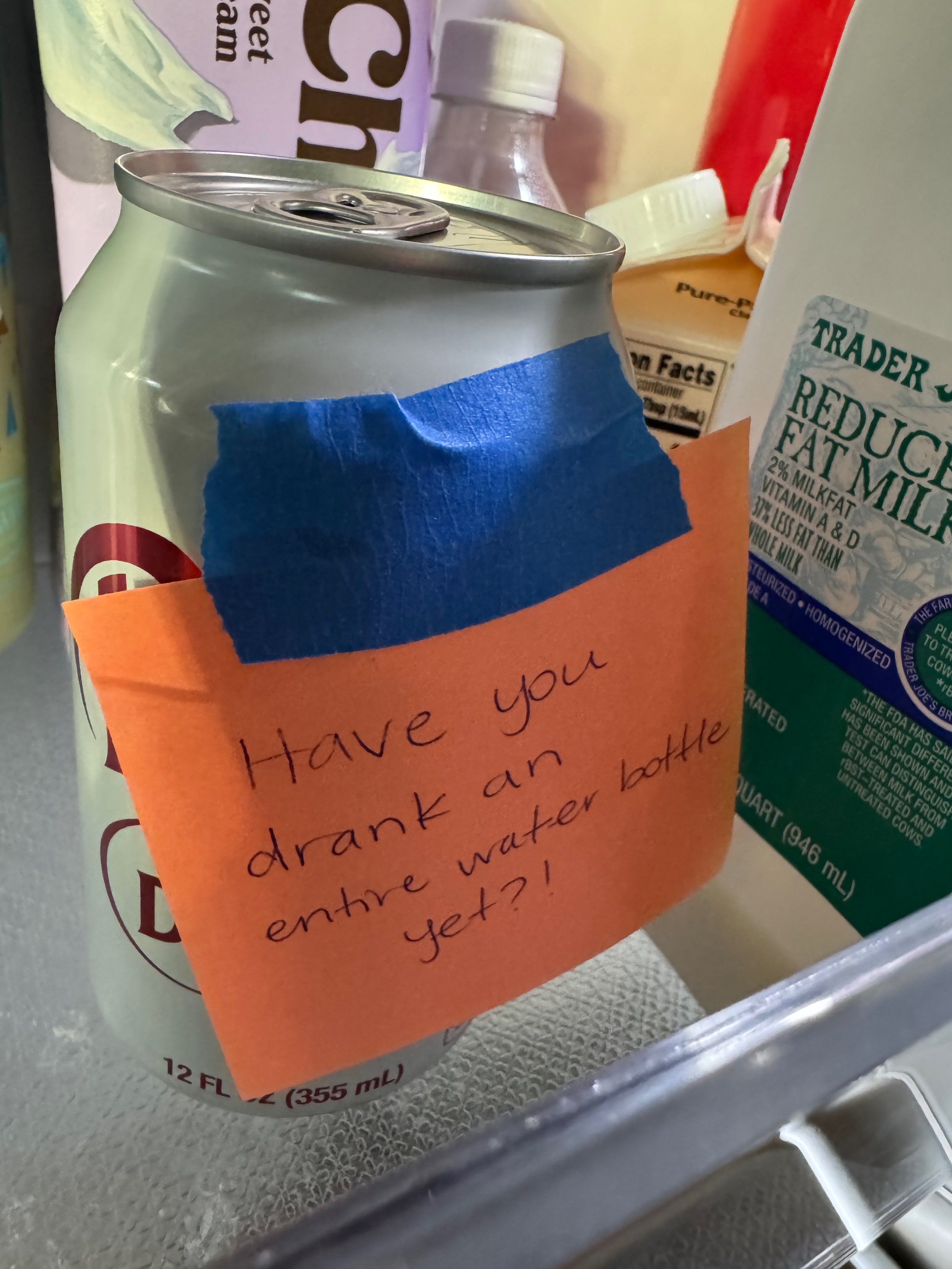
We live in a world where it’s easy to react quickly. Send the text, order the takeout, post the tweet. Not all writing needs to be reflective; sometimes it’s just practical. Small written cues can act as anchors to reduce decision fatigue, like a note on your fridge reminding you to eat the veggies you sliced up, or the reminder on your phone to drink water each hour, or block you put in your planner to take a walk when the work day ends.
When we think about behavior change, the goal isn’t to make better decisions every single day from scratch. Can you imagine how much work that would take?!? And maybe you can imagine, because you’ve lived it! A goal of behavior change is to make fewer decisions, and having things written down, especially when they serve as reminders, can do some of the heavy lifting of remembering for you.
WRITING MAKES PROGRESS MORE VISIBLE
Our brains are wired to notice problems, not progress. In the course of a week, we might remember the workout we skipped (but forget the three we completed) or fixate on the one prepped meal we feel like we wasted because of last minute dinner plans (but overlook the breakfast and lunch we prepped and took to work with us every day).
Writing things down can create evidence. And yes, sometimes this evidence is one of a plan that was created and not followed, and even then, I will die on the hill that that is growth, because it creates space for a feedback loop of reflection to begin.
And, more often than not, this evidence points to progress. That a situation was handled differently than in the past, or that you’re actually more consistent than you think. It highlights the tools that you’ve gathered and the growth you’re experiencing.
WRITING BUILDS OWNERSHIP
There’s something powerful about committing words to paper. It shifts your intentions into something a bit more tangible. (Have you ever felt this?)
Commitment feels different when it’s written as opposed to just thought. Plans that stay in our heads are easy to renegotiate (and also easier to forget). There is an intention behind writing something like: “my focus this week is to have protein every day with breakfast” or “I’m going to make sure my plate has a color on it for at least two meals a day” or “bed by 9:30pm!!!”
If all of this feels a little woo-woo, I want to also clarify that writing doesn’t guarantee follow-through. But it does strengthen it.
WRITING IS A TOOL, NOT A PERFORMANCE
Let’s get clear about another thing: this doesn’t mean you need a color-coded planner or a 10-step reflection ritual. (You can have these if you want them! But they’re not a requirement.)
It can look like:
Bullet points in your Notes app
A sticky note with your focus for the week
Time reserved in your calendar for you with reminders like “walk about the office” or “fill your water bottle” or “take a deep breath”
A daily/hourly reminder to have a timer go off with a specific note
SO:
Here’s the thing: nutrition and health goals don’t fall apart because we don’t care. They often fall apart because we don’t have a strategy to implement them that makes sense to us.
And one of the ways that we can get really clear on what we want (our expectations, goals, to-dos, schedules, grocery lists, bedtime routines, etc.) is to write things down so that they are visible, instead of staying hidden (or lost) in our brains.
While it might seem simple, and maybe almost even mundane, writing things down is one of the most powerful tools we have when it comes to clarity, follow-through, and behavior change.
YOUR NEXT STEP
Does this blog post resonate with you? At Front Porch Nutrition, I coach real people through real-life nutrition — thinking through what your wants, needs, and goals are, and working together to make changes that last not just in the moment, but for the long haul. Get started with 1:1 nutrition coaching today!