WHAT IS BODY RECOMPOSITION? (THE SCALE IS NOT THE WHOLE STORY)
If you've ever said, "I don't really care what the scale says, I just want to look and feel stronger," you've probably been talking about body recomposition. (Or if you’ve ever been questioned by me about something along the lines of “if the scale never changed but life and your abilities did, would that matter?” that falls into this bucket, too.
Body recomposition (or simply “recomp”) refers to changing your body composition by building muscle while reducing body fat. Unlike a traditional weight loss phase, where the primary goal is to see the number on the scale go down, recomposition focuses on what your body is made of, not just how much it weighs.
Because muscle is denser than fat, the scale may not change much (or at all) even though your body is changing in meaningful ways.
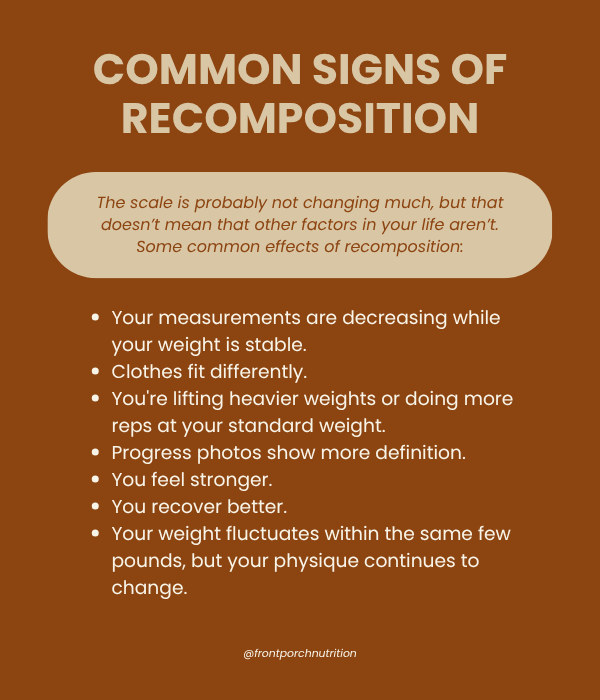
WHAT DOES BODY RECOMPOSITION LOOK LIKE?
For someone who is new to strength training or just beginning to consistently fuel their body well, body recomposition can happen relatively quickly.
Imagine someone who starts lifting weights three to four times per week while also prioritizing enough protein and overall nutrition. In the first several months, they may notice:
Clothes fitting differently
Improved muscle definition
Increased strength in the gym
Better energy levels and improved recovery
Progress photos showing visible changes
Little or no movement on the scale
This is one reason I encourage clients to use multiple ways to measure progress. If you only rely on your weight, you may completely miss the changes happening beneath the surface; if you are only focusing on the number on the scale, you may miss what you see in the mirror, in daily life, and on the training floor.
THE BEGINNING: “NEWBIE GAINS”
When you're new to strength training or eating a bit more intentionally, your body responds incredibly well to the new stimulus. Especially when we think in terms of what is happening at the gym, this is often referred to as "newbie gains."
You're learning movement patterns, building muscle more efficiently, and becoming stronger relatively quickly. If you're also improving your nutrition — perhaps by eating more protein, adding more fruits and vegetables, or creating more consistency with your meals — you've created an environment where your body can both build muscle and lose body fat.
These changes are exciting, but they (the gains) also tend to be temporary, because eventually, our bodies adapt. (Stick with me here, this doesn’t sound glamorous, but is meant to paint a realistic picture.) The longer you've been strength training consistently and the more advanced you become, the harder it is to continue building muscle and losing fat at the same time. Muscle growth slows. Fat loss becomes less automatic. Progress requires more intention.
This potential “slowness” of progress doesn't necessarily mean you've hit a plateau — it is a great indicator that you've become more trained. I get that this might feel frustrating, especially if you are still close enough to the beginning of your journey and have more recent evidence of things moving quickly. For many people, long-term progress often looks less like continuous recomposition (at least at a quick rate) and more like spending intentional periods focusing on one goal at a time.
CAN RECOMP HAPPEN IN DIFFERENT NUTRITIONAL PHASES?
Can body recomposition happen in a calorie deficit? Yes, but with some caveats.
If you're newer to lifting, returning after a break, carrying a higher body fat percentage, or simply improving your nutrition after a long period of inconsistency, it's absolutely possible to build muscle while eating in a modest calorie deficit.
Your body has stored energy available to support muscle growth, especially when you're strength training consistently and eating enough protein. However, as deficits become larger or are maintained for longer periods of time, building muscle becomes much more difficult; your body has fewer resources available to support growth because its primary focus is meeting basic energy needs. We typically, at best, see muscle mass stay consistent and fat loss be the outcome of the deficit, and at worst, a deficit can result in the loss of both muscle and fat. This is one reason I rarely recommend aggressive dieting (too steep and/or for too long) for people who also want to improve performance in the gym.
What about body recomposition in a calorie surplus? A small calorie surplus generally creates a better environment for building muscle.
When your body has extra energy available, it can devote more resources to recovery and muscle growth. The tradeoff, though, is that many people will also gain some body fat alongside that muscle. This isn't a failure — it's simply part of the process.
Many people intentionally spend time in a slight surplus to maximize muscle gain before later spending time in a moderate calorie deficit to reduce body fat while maintaining as much of that new muscle as possible. This approach is often called a "build phase" followed by a "fat loss phase."
WHICH APPROACH IS BEST?
It depends. It depends on your goals, your training experience, and where you're starting.
If you're just getting started with strength training, improving your nutrition, or coming back after time away, body recomposition is a realistic possibility. You may see impressive changes without needing to chase either an aggressive calorie deficit or a large calorie surplus.
If you've been training consistently for years, however, your expectations may need to shift. Progress becomes slower, more deliberate, and often more focused on one primary goal at a time. It’s important to remember what you're actually chasing, and that can be highly personal.
I’d encourage you to take a step back here and encourage you to evaluate what progress you are trying to make. When it comes to the idea of recomposition, at the root of it, most people aren't actually chasing a number on the scale (bold, but I think very valid, claim). They're chasing confidence, strength, and possibly aesthetics – all reasonable. With the recomposition of carrying more muscle, many are aiming to hike with their families, get on the ground and play with their kids/grandkids/pets, carry all the groceries into the house in one load (🙋🏻♀️), feel comfortable in their clothes, or see the muscles they’ve been working hard to build.
Body recomposition can absolutely help you move toward those goals — and it's important to remember that it's a phase, not a permanent state. The longer you've been training, the more strategic your nutrition and programming often need to become.
And: while I talk endlessly about the beauty of being in maintenance for 90% of your life, the reality is that depending on your starting point, it might not be enough to move the needle if recomposition is your goal. That may very well take some transitioning between nutritional phases to achieve.
SO…THE GOOD NEWS
Whether you're in a maintenance phase, a calorie deficit, or a slight surplus, strength training, adequate protein, and consistency remain the foundation. Those habits continue to pay dividends long after the "newbie gains" have faded, and they're what ultimately lead to lasting results.
YOUR NEXT STEP
Does this blog post resonate with you? At Front Porch Nutrition, I coach real people through real-life nutrition — thinking through what your wants, needs, and goals are, and working together to make changes that last not just in the moment, but for the long haul. Get started with 1:1 nutrition coaching today!